In this guide 6 sections
A cleanroom can look pristine while its filtration performance is quietly slipping. Rising pressure drop, unstable airflow, damaged gel seals, or a poor installation can allow contamination risk to grow long before anyone sees visible evidence. That is why cleanroom filter replacement is not a routine housekeeping task. It is a controlled maintenance event that affects classification, product quality, operator safety, and production uptime.
For lab managers, facilities teams, and quality engineers, the goal is not simply to install a new HEPA or ULPA filter on a calendar date. The goal is to maintain the air pattern and particle-control performance your process actually requires. A disciplined approach turns filter changes from an emergency response into predictable, documentable work.
When Does a Cleanroom Filter Need Replacement?
The most useful answer is: it depends on the filter location, the room classification, the process load, and the HVAC design. A terminal HEPA filter above a sensitive assembly area is not managed the same way as a prefilter protecting an air handling unit. Still, replacement decisions should be based on evidence rather than appearance alone.
Differential pressure is one of the clearest operating signals. As a filter loads with particulate, resistance increases and the fan must work harder to move air through it. Every system should have established baseline pressure readings after commissioning or after a verified filter installation. Compare current readings against that baseline and the equipment manufacturer’s final resistance recommendation. A sudden change may point to a damaged filter, a failed gauge, a damper issue, or an upstream contamination event rather than normal loading.
Airflow and room pressurization matter just as much. If supply volume falls, air changes per hour may no longer support the room’s required recovery performance. If the pressure cascade between adjacent spaces becomes unstable, contaminants can travel in the wrong direction. In pharmaceutical, electronics, optics, and precision manufacturing environments, that shift can affect yield long before it causes an obvious alarm.
Replacement may also be necessary after a failed integrity test, water exposure, construction activity, a contamination incident, visible media damage, or compromised gasket and gel-seal surfaces. A filter that passes pressure checks but fails an aerosol scan is not fit to remain in service. Conversely, replacing a filter solely because it has reached an arbitrary age can create unnecessary cost and disruption if test results and operating conditions remain acceptable.
Plan Cleanroom Filter Replacement Before the Shutdown
The replacement itself may take hours, but a reliable changeout starts well before the work area is opened. Review the room’s current status, the filter schedule, recent particle-count data, pressure trends, and the last certification report. This creates a defensible reason for the change and helps the team recognize issues that a new filter alone will not solve.
Confirm the exact filter specification from approved drawings, equipment records, or the existing validated bill of materials. Dimensions are only the start. Match the required efficiency, face velocity, media type, frame material, gasket location, seal method, fire rating, and pressure-drop characteristics. A HEPA filter is not automatically interchangeable with another HEPA filter, especially in terminal housings designed for a particular gasket orientation or knife-edge gel seal.
For critical rooms, verify that the replacement filter has appropriate documentation, including lot identification, efficiency test information, and any certifications required by the site’s quality system. Keep filters wrapped until they enter the controlled staging area. Damaged corners, punctured packaging, compressed pleats, or wet cartons should trigger inspection before installation. A pristine white frame does not guarantee intact media inside.
Coordinate the outage with operations, environmental health and safety, maintenance, and quality assurance where applicable. The work plan should define which rooms are affected, whether nearby processes must stop, how the work zone will be contained, and what tests are required before the area returns to use. This is particularly important where hazardous powders, biologic materials, solvents, or high-value optical assemblies are present.
The Installation Details That Protect Performance
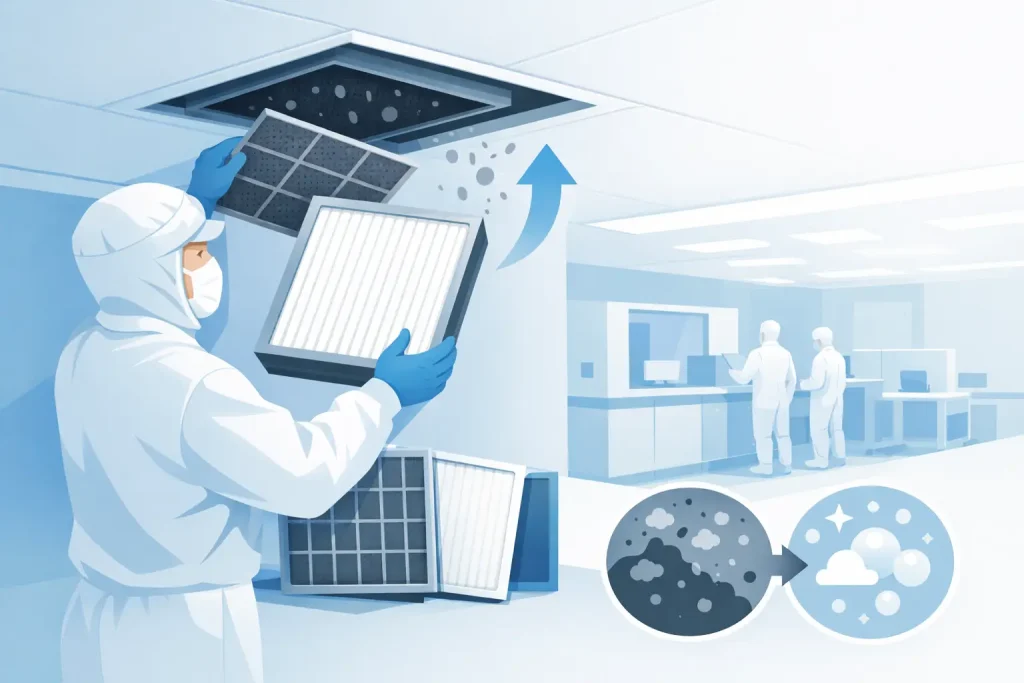
A filter changeout should be performed by trained personnel using the facility’s approved procedures. The team needs appropriate gowning and, when the process calls for it, containment measures that keep debris from migrating into adjacent controlled spaces. For high-hazard applications, bag-in/bag-out housings or other engineered containment systems may be required.
Before removal, record the existing pressure reading and inspect the housing, retaining hardware, knife edge, clamps, and access door. Remove loose debris using approved methods. Do not scrape a gel-seal channel aggressively or use cleaners that are incompatible with the seal material. Small imperfections, old gel residue, or warped hardware can become the real reason a newly installed filter fails its scan test.
Handle replacement filters by the frame, not the media or protective screen. Avoid setting them on corners or sliding the frame across rough surfaces. Pleated media is engineered to capture particles while maintaining airflow; a crease, tear, or disturbed seal can compromise that balance. In fan filter units, follow the manufacturer’s torque pattern and electrical safety steps rather than treating the unit as a simple ceiling tile.
Once positioned, ensure the gasket compresses evenly or the knife edge seats correctly into the gel. Uneven clamp tension can cause bypass leaks even when the filter itself is perfectly manufactured. Reinstall diffusers, access panels, and hardware carefully, then allow the system to stabilize before final verification.
Test the Room, Not Just the New Filter
The strongest cleanroom filter replacement program treats installation and verification as one process. A new filter is not proven effective because it fits in the housing or because airflow can be felt at the diffuser.
For terminal HEPA and ULPA filters, an aerosol photometer scan test is commonly used to identify leaks in the media, frame, gasket, and housing interface. The test method, challenge aerosol, scan speed, acceptance criteria, and technician qualifications should match the facility’s applicable standards and internal procedures. Critical environments may also require particle counting, airflow velocity or volume measurements, air-change calculations, and pressure-cascade verification.
Recovery testing can be valuable after a major event, especially if several filters were replaced or the HVAC system was shut down. It shows how quickly the room returns to acceptable particle conditions after a defined disturbance. This is where a cleanroom reveals whether the issue was truly filtration or whether airflow balance, leakage, door behavior, process equipment, or housekeeping practices are also contributing.
Document every result. At a minimum, retain the filter location, model and lot details, installation date, pre- and post-change pressure readings, integrity-test results, corrective actions, and approval to release the room. Good records make future troubleshooting faster and allow procurement teams to forecast replacements before an urgent outage puts them at the mercy of limited inventory.
Avoid the False Economy of “Close Enough” Filters
A lower-priced filter can look attractive during a maintenance budget review, but the cost of a mismatch may be much higher than the purchase price. Incorrect resistance can change airflow distribution. An incompatible frame or seal can create bypass. A filter without traceable performance data can complicate qualification. In a precision optics area, a particle event may mean rework or rejected components; in a regulated operation, it can create a serious documentation problem.
That does not mean every application needs the highest-efficiency, lowest-penetration filter available. Higher efficiency often brings higher resistance, and a system may need adjustment to maintain designed airflow. The right choice is the filter that meets the room’s specified performance within the capabilities of its housing and air-handling system.
A practical inventory strategy can reduce pressure when a replacement is needed. Keep approved spare filters for critical sizes and long-lead configurations, but store them in clean, dry, protected conditions. Review shelf inventory periodically, because a spare with damaged packaging is not a dependable contingency plan. For facilities supporting multiple rooms, standardizing approved filter types where engineering allows can simplify purchasing, training, and emergency response.
Build a Replacement Program Around Trends
The best time to plan a filter replacement is when the room is still operating normally. Trend differential pressure by location, compare it with airflow and particle data, and investigate abrupt deviations. Track changes by season and production cycle as well. A room near machining, packaging, renovation, or a dusty loading area may load filters very differently from a quiet metrology lab.
Set action limits that prompt inspection before final limits force a shutdown. Pair those limits with a clear escalation path: inspect gauges and fan performance, review upstream prefilters, check dampers and door seals, then decide whether a terminal filter change is justified. This sequence prevents teams from replacing an expensive HEPA filter when the root cause is an overlooked upstream problem.
Cleanroom filtration may sit above the work floor, out of sight, but it is part of the precision infrastructure behind every reliable measurement, clean assembly, and controlled process. Treat each replacement as a verified performance event, and your facility will be better prepared to protect both its clean air and the work that depends on it.