
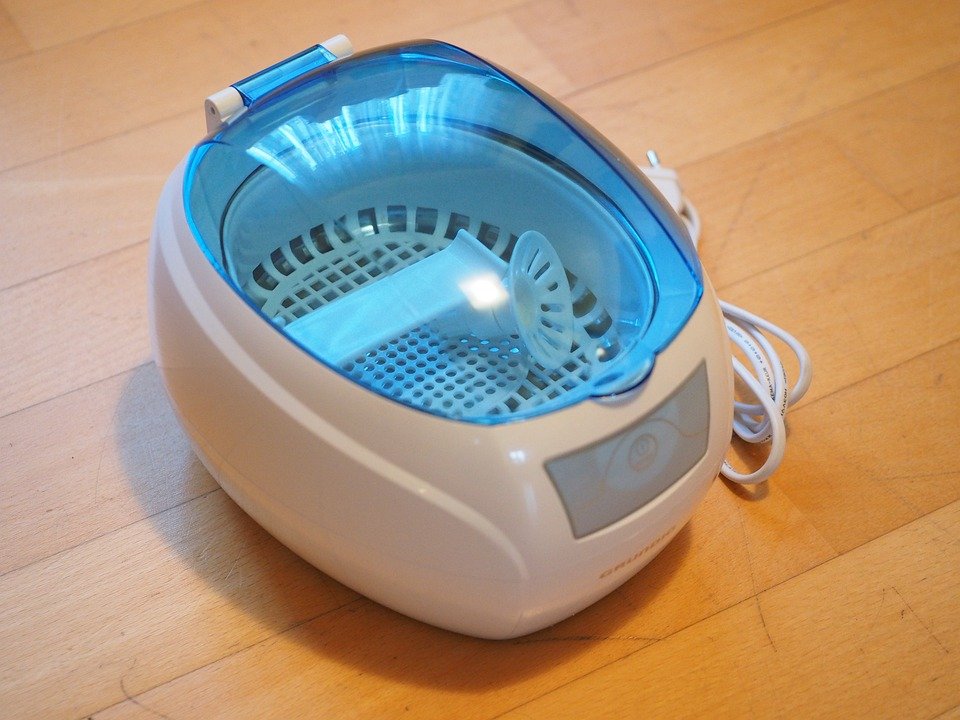

The best ultrasonic cleaner for your work is one that fits your parts, uses a compatible cleaning process and delivers a result you can check. A large tank or a high advertised wattage alone does not tell you that. Start with the item and the dirt you need to remove, then compare equipment.
This guide is a buying checklist for home and small-workshop use, not a hands-on ranking of specific models. For production equipment, see our guide to industrial ultrasonic cleaning systems.
Start with the cleaning job
Write down the largest item’s dimensions, its materials and finishes, the contaminant, and how many items you need to clean at once. Include coatings, adhesives, seals and assembled components: compatibility of the main metal does not establish compatibility of the whole object. Ask the item’s manufacturer whether immersion and ultrasonic cleaning are permitted before buying a machine.
An ultrasonic bath uses sound energy in a liquid to help dislodge contamination. It does not make every material safe to immerse, and it does not automatically leave an item ready for use. Rinsing, drying and inspection may still be necessary.
Which type should you consider?
| Your situation | What to compare first | Question to resolve |
|---|---|---|
| Occasional small-item cleaning | Usable basket dimensions, simple controls and a clear manual | Is ultrasonic cleaning approved for the exact item? |
| Workshop parts with recurring oil or residue | Compatible chemistry, useful working depth, drain access and permitted operating duty | Will the complete cleaning and rinsing process remove the actual soil? |
| Several different delicate components | Supplier application support and documented control options | Can the supplier demonstrate acceptable results without surface damage? |
| Repeated production batches | Loading fixtures, repeatability, service and total process capacity | Would a purpose-designed industrial system better suit the job? |
Tank size: measure the basket, not just the liters
Compare the usable dimensions of the basket or fixture with your largest part. A capacity label is not a promise that a similarly sized object fits under the working liquid level. Allow space for the support, the prescribed fill level and the loading arrangement. Ask for a dimensioned drawing when a fit is close.
Also measure the bench space needed to lift the lid and basket, handle wet parts and reach the drain. A larger machine may be inconvenient if you cannot empty or clean it easily. Our guide to ultrasonic cleaner accessories explains the equipment to include in that fit check.
Read the specifications beyond “digital” and “powerful”
- Timer: Check its usable range and whether repeat cycles suit the intended workload. A digital display does not prove the machine offers adjustable frequency or ultrasonic power.
- Temperature control: Confirm whether the exact model has a heater, a temperature display, both or neither. Verify that the approved process stays within the item’s and fluid’s temperature limits.
- Power: Ask which figure refers to ultrasonic output and which to heating or total electrical consumption. Compare like-for-like specifications instead of treating the largest number as a cleaning score.
- Frequency and modes: Fixed-frequency, selectable-frequency, sweep and degas are different features. Buy a feature because your process needs it; see ultrasonic frequency selection.
- Service: Check access to the manual, replacement baskets, repair support and the seller’s return terms before ordering.
For a US purchase, confirm the voltage, frequency, plug and electrical requirements of the exact model offered by the seller. Specifications on an overseas manufacturer’s page may describe another version.
Choose the fluid before choosing the cycle
A cleaner, detergent and item form one process. Obtain a compatible fluid recommendation and follow its dilution and temperature instructions, together with the equipment manual. Do not improvise with flammable solvents in an ordinary ultrasonic bath. Our guide to choosing ultrasonic cleaning fluids covers the questions to ask when comparing products.
There is no universal three-minute or six-minute cycle for every object. Use the approved procedure for your combination, inspect the result, and avoid escalating time, heat or chemical strength simply because the first result is disappointing. The problem may be loading, chemistry or an unsuitable application.
Important limits for jewelry and clinical instruments
GIA’s jewelry guidance warns that ultrasonic cleaning can damage some gems and treatments or loosen stones. Pearls, amber and fracture-filled gems are among the concerns. If the material, treatment or setting is uncertain, ask a qualified jeweler before using a bath.
Ultrasonic cleaning is not sterilization. The CDC distinguishes cleaning from disinfection and sterilization. Clinical instruments require their validated reprocessing instructions; a consumer buying guide cannot establish a safe clinical process.
Compare the complete purchase
Build a shortlist with columns for exact model, usable basket size, approved application, included accessories, chemistry, US electrical version, warranty and total delivered cost. Include supplies and accessories in your budget. An apparently cheaper unit may need a basket, lid or handling equipment that another package includes.
Affiliate disclosure: As an Amazon Associate, Optodir earns from qualifying purchases. You can compare ultrasonic cleaner listings on Amazon.com. Check the exact variant and current details on the seller’s page; this link is a starting point for comparison, not a claim that every listed product suits your items.
Before the first use
Read the model’s full manual and the item’s care instructions. Prepare a suitable work area and a way to rinse, dry and inspect the item. The Bransonic quick-start guide, for example, specifies a working fill level, degassing and supported loading. Follow the instructions for your own machine, including its operating limits.
Keep a simple record of the approved fluid, loading and settings that produced an acceptable result. If an item’s finish changes or the process does not meet its cleaning requirement, stop and seek application-specific advice rather than assuming a stronger setting will solve it.