In this guide 6 sections
The first time a smart telescope stacks a faint nebula into a colorful image on your phone, it can feel like the backyard has opened directly onto deep space. This smart telescope review looks past that impressive first reveal to answer the question that matters before you buy: will an automated, app-controlled telescope make you use astronomy gear more often, or leave you wishing for a traditional scope?
For many beginners, families, apartment dwellers, and busy hobbyists, the answer is encouraging. Smart telescopes remove several barriers that make visual astronomy intimidating: polar alignment, star hopping, focus checks, camera settings, and post-processing. But they are not universal replacements for an eyepiece telescope. Their strengths are real, their limits are real, and choosing the right one depends on the kind of night sky experience you want.
What a Smart Telescope Actually Does
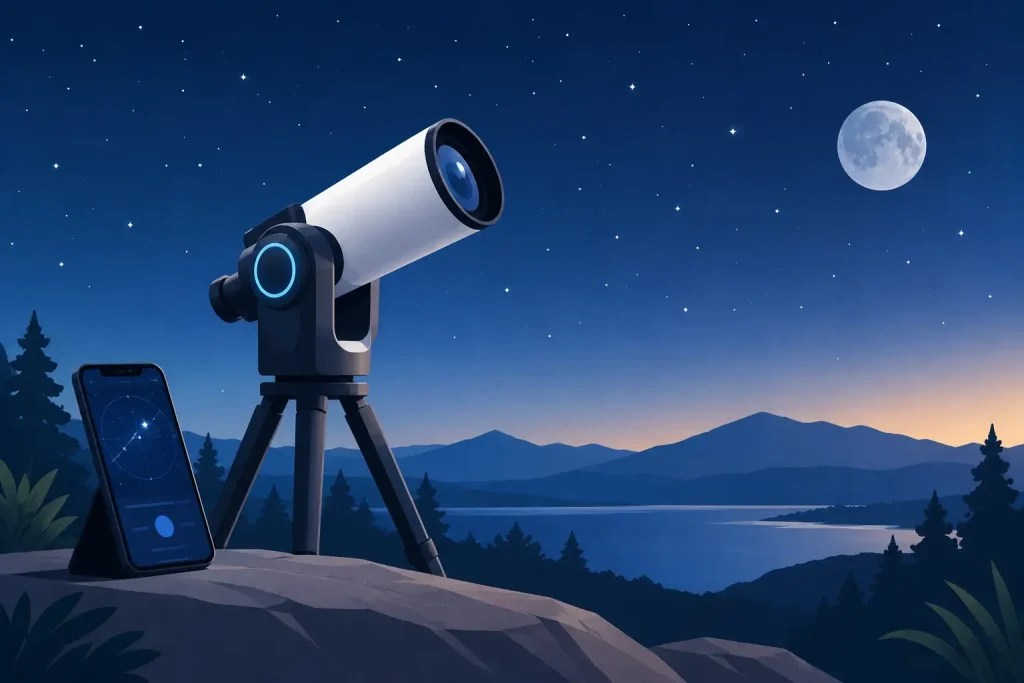
A smart telescope combines a compact optical tube, digital image sensor, computerized mount, and mobile app. Instead of locating a target manually, you select an object from an in-app catalog. The telescope uses onboard sensors and plate solving – identifying stars in its own camera view – to orient itself, slew to the object, track it, and capture a series of short exposures.
Those exposures are then aligned and stacked. Stacking reduces random image noise and gradually reveals detail that a single exposure cannot show. This is why a smart telescope can produce a satisfying image of the Orion Nebula or Andromeda Galaxy from a suburban yard even though the object may look faint through a small traditional eyepiece.
That distinction is crucial. A smart telescope is primarily an electronically assisted astronomy and astrophotography instrument. You are viewing a live, accumulating digital image, not placing your eye at the focal plane. For some people, that is the whole appeal. For others, especially observers who love the direct glow of Saturn through an eyepiece, it is a trade-off rather than an upgrade.
Smart Telescope Review: The Best Reasons to Buy
The strongest case for a smart telescope is time. A conventional telescope can be wonderfully hands-on, but getting from a packed case to a well-framed galaxy often requires patience and a working knowledge of mounts, coordinates, balancing, alignment, and optics. A good smart model cuts that process down dramatically.
Setup is usually limited to placing the instrument on stable ground, powering it on, connecting the app, and allowing it to calibrate. That convenience changes the odds that a family will take it outside on a weeknight or that a new hobbyist will observe during a short gap in the clouds. If astronomy gear is easy to deploy, it is far more likely to become part of your routine.
The image-sharing experience is another major advantage. A child can watch the Pleiades build on a tablet screen, a teacher can project a live session for a classroom, and a beginner can save a polished image without learning a desktop editing workflow first. Instruments such as the ZWO Seestar, Vaonis Vespera line, Unistellar models, and Dwarf smart telescopes have helped make deep-sky imaging more accessible because they package difficult processes into guided software.
Smart scopes can also be excellent under moderate light pollution. They do not defeat a bright sky, haze, or nearby streetlights, but digital stacking and built-in processing make many nebulae and star clusters more attainable than they are through a small visual telescope. A dark-sky trip still delivers better data and more dramatic results, yet you do not have to wait for a vacation to begin exploring the cosmos.
Where Smart Telescopes Fall Short
The polished app experience can create an expectation that every target will look like a space-agency image. That is not how it works. A compact smart telescope has limited aperture, a fixed optical design, and a small sensor compared with an advanced interchangeable-lens astrophotography setup. Bright, large targets often look excellent. Small galaxies, dim planetary nebulae, and fine planetary detail demand more from the optics and conditions.
Moon and planet viewing are another area where traditional telescopes can win. The Moon is a rewarding smart-telescope target, particularly for saved images and casual sharing. Jupiter and Saturn can be captured, too, but a dedicated planetary setup with a larger aperture, longer focal length, and high-frame-rate camera will reveal substantially more detail when the atmosphere cooperates.
There is also less room to grow through hardware changes. With a traditional telescope, you can switch eyepieces, add filters, change cameras, experiment with reducers, upgrade a mount, or build a system around a particular imaging goal. Smart telescopes are designed as integrated instruments. Their simplicity is their engineering advantage, but it also means accepting the manufacturer’s sensor, lens or mirror, app features, and target workflow.
Finally, battery life, Wi-Fi reliability, dew, and software support matter. A telescope that is effortless in a product video still needs a charged battery and a stable connection outdoors. Dew can soften images on humid nights, and app updates occasionally alter features or introduce temporary bugs. Look for an active support ecosystem and realistic user feedback, especially if you expect to use the telescope often.
Which Buyer Gets the Most Value?
A smart telescope is an especially strong fit for beginners who want early success, parents who want a science-focused activity that holds attention, and photographers who care more about finished sky images than manual telescope operation. It also makes sense for travelers and urban observers who value a compact, fast setup over maximum aperture.
It may be less satisfying for the observer whose dream is to learn the sky manually. A classic Dobsonian or refractor paired with a star chart, astronomy app, and a few well-chosen eyepieces teaches celestial navigation in a tactile way. It is also often the better value for visual observing. Dollar for dollar, traditional optics generally provide more aperture, and aperture remains valuable for seeing faint objects with your own eyes.
There is no rule that says you must choose one path forever. A smart scope can be the low-friction tool for quick imaging sessions, while binoculars or a manual telescope provide the immersive visual experience. That combination can ignite a lasting passion for the cosmos without turning every clear night into a technical project.
What to Compare Before You Choose
Do not shop by megapixels alone. Optical speed, aperture, sensor size, field of view, mount accuracy, processing software, and target catalog all shape the final experience. A wide-field smart telescope excels at expansive nebulae, open clusters, and larger galaxies. A narrower-field instrument may frame smaller deep-sky objects more effectively but can be less forgiving when conditions are poor.
Pay close attention to portability. Some models are genuinely grab-and-go, with an integrated tripod and battery, while others still need a separate tripod or a heavier carrying case. If you live in a city apartment or expect to carry the telescope to a campsite, a few pounds and a few extra setup steps can make a meaningful difference.
Consider the app as part of the instrument, not a minor accessory. Can it show a live preview? Does it provide useful framing controls? Are raw files available for later editing? Does it support mosaic modes for larger targets? Is target selection easy for a complete beginner? The telescope may have capable optics, but the app determines how clearly you can use them in the dark.
A practical checklist helps keep the comparison grounded:
- Choose a wide field of view for large nebulae, clusters, and easy framing.
- Prioritize battery runtime and dew control for longer outdoor sessions.
- Check whether the telescope saves editable image files, not only processed JPEGs.
- Confirm that its size, tripod needs, and carrying case suit where you will observe.
Expectations Make the Difference
A smart telescope does not replace the experience of spotting a crescent Moon through an eyepiece or sweeping a dark sky with binoculars. It offers something different: a guided route to images that once required a much steeper learning curve. That is a meaningful change for people who have admired astrophotography from a distance but never felt ready to assemble a complex rig.
For the right buyer, the best smart telescope is not necessarily the one with the longest specification sheet. It is the one you will carry outside, point toward a clear patch of sky, and use enough to make the universe feel close.